What Homogeneous Sheet Vinyl Is, and Where It Belongs
Homogeneous sheet vinyl is a single-composition resilient sheet where the colour and pattern run through the full thickness of the material. There is no printed film and no separate wear layer to abrade through, which is why it survives decades of rolling clinical traffic and why it can be refinished rather than replaced when it dulls.
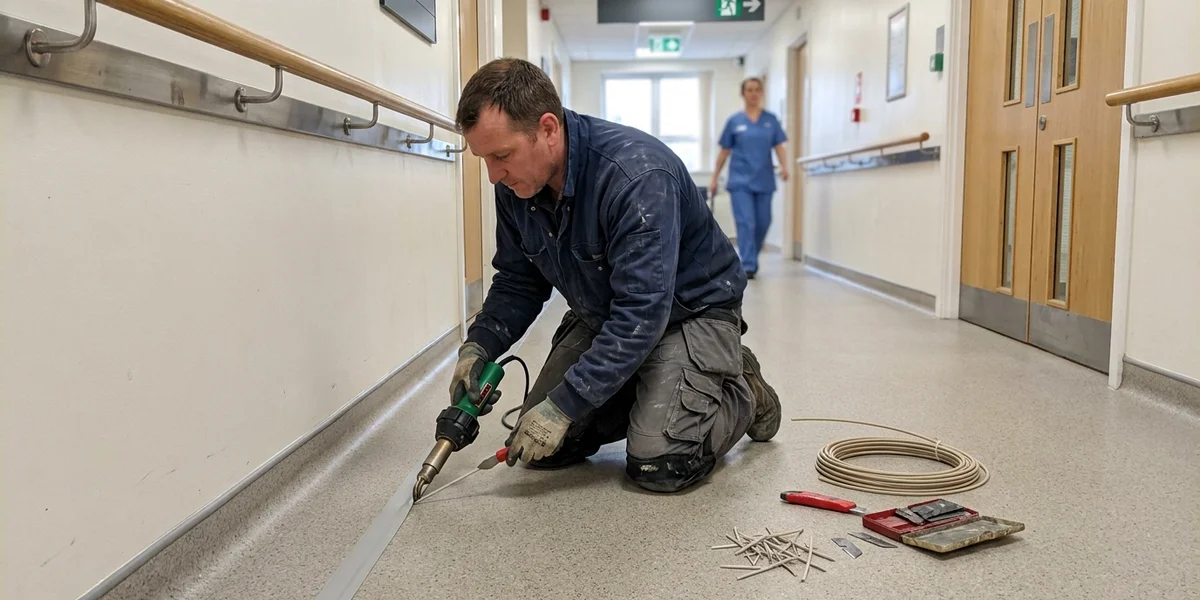
What makes it a healthcare material is not the sheet, it is the detailing. Seams are grooved and hot-air welded with a matched rod, then skived flush, so there is no joint for fluid to enter. At the wall the sheet turns up over a cove former as a 4 or 6 inch integral flash coving and is capped, which removes the floor-to-wall junction entirely. The finished surface is continuous, non-porous, and antimicrobial, and it can be cleaned to the standard that CSA Z8000 infection control expects.
That is a different product decision from picking a colour. It is why Commercial Flooring Toronto treats welded sheet vinyl as a specialty rather than a line item, and why the quote breaks out coving, weld, and substrate prep separately.
5 Facility Types Where We Install Welded Sheet Vinyl
- Hospitals and long-term care. Corridors, nursing stations, patient rooms, and soiled utility, with Polyflor Bloc and Tarkett iQ the common specifications.
- Dental, medical, and veterinary clinics. Treatment rooms, sterilisation bays, and imaging suites, where the coved junction matters as much as the sheet.
- Cleanrooms and laboratories. ISO-classified spaces where particulate control rules out tile joints entirely.
- Schools, daycares, and institutional washrooms. Altro safety flooring with R10 or R11 slip resistance and welded coving to the drain.
- Commercial kitchens and food service. Seamless surfaces with coving where a jointed floor would fail a health inspection.
How Much Does Homogeneous Sheet Vinyl Cost in Toronto?
A homogeneous sheet vinyl installation in Toronto costs $8 to $22 CAD per sq ft installed. Standard lines sit at the bottom of that range, healthcare lines with integral coving in the middle, and Altro safety or wet-area systems at the top.
| Cost factor | Effect on the installed rate |
|---|---|
| Material line | Standard $8 to $12, healthcare $12 to $18, safety and wet area $16 to $22 CAD per sq ft |
| Integral coving | 4 inch adds less than 6 inch; both add former, cap, and labour at the perimeter |
| Substrate condition | Self-levelling underlayment and grinding add $2 to $6 CAD per sq ft |
| Existing floor removal | $1.50 to $4 CAD per sq ft, higher where cut-back adhesive is present |
| Moisture mitigation | Certified epoxy vapour barrier priced separately once test readings are in |
| Work window | After-hours and weekend phasing adds 25 to 40 percent on labour |
Where the budget usually moves
Not the sheet. It is the substrate. A slab needing grinding, adhesive removal, self-levelling, and a moisture mitigation membrane can add more per square foot than the material itself. That is why we assess the substrate before issuing a number instead of pricing off a floor plan.
When Do You Need to Replace, Not Repair?
Replace when the existing floor has failed on hygiene rather than looks. Lifting seams, gaps at the wall junction where the base has pulled away, staining that will not respond to a neutral clean, and VCT flagged at an Ontario Public Health inspection are all replacement triggers, because none of them can be corrected by refinishing.
Repair is reasonable where the sheet itself is sound and the damage is local: a burn, a gouge, or a single failed seam can be cut out and welded in if the line is still in production. Where the original is discontinued, a patch will read as a patch and we will tell you that before taking the work.
The moisture question decides more replacements than wear does. If a floor has already failed once on adhesive, the slab is the suspect until ASTM F1869 and F2170 testing says otherwise.
Coordination, Compliance, and the Rest of the Scope
Welded sheet vinyl rarely arrives on its own. A clinical fit-out usually pairs it with commercial LVT in reception and administrative areas, where hard surface performance is needed but coving is not, and institutional projects often run it alongside Forbo Marmoleum where a LEED v4 low-emitting materials credit is in play.
On a tenant improvement or a hospital project run under a general contractor, our commercial flooring contractor scope covers CCDC 2 coordination, current WSIB clearance, $2M commercial general liability, MPI subfloor prep specifications, and the EPD and HPD submittals your project team needs for the file.
Every installation is carried out by INSTALL certified, directly employed crews, verified seam by seam, and closed out with a written workmanship warranty alongside the manufacturer documentation.