GTA Dispatch Active Today
verified_user INSTALL Certified & WSIB Clear
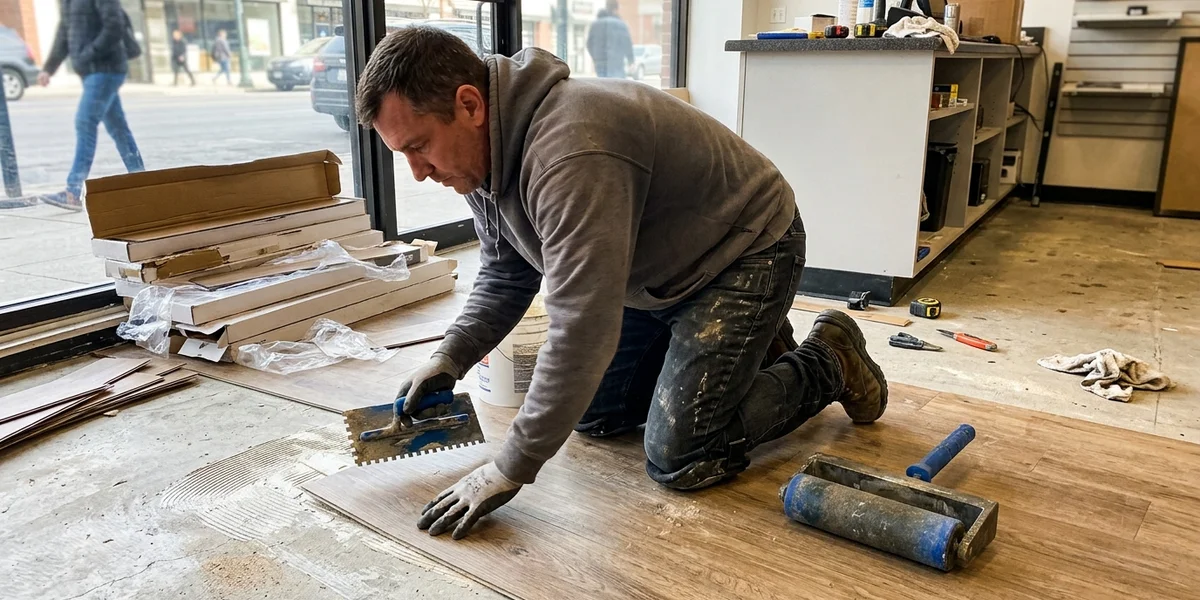
Installer rolling glue-down luxury vinyl plank into adhesive across a retail unit floor
20+ Years Commercial Experience WSIB Certified · $2M CGL

Commercial LVT and VCT for GTA Offices, Retail, and Hospitality

Commercial LVT in Toronto is Commercial Flooring Toronto installing Karndean, Amtico, Shaw, and Marley Flexco luxury vinyl tile and VCT with 20 mil and 30 mil commercial wear layers, glue-down and rigid-core SPC formats, and acoustic backing, for offices, retail centres, condo corridors, universities, and hospitality across the GTA. Our crews handle FloorScore-certified material sourcing, ASTM F1700 compliance, self-levelling substrate prep, moisture testing, and acoustic underlayment on one written quote. A commercial LVT installation in Toronto costs $5.50 to $14 CAD per sq ft, with VCT at $3.50 to $6.50 CAD per sq ft, depending on wear layer, format, and prep. Most calls start with a trigger: a retail plaza fit-out needing LVT between openings, a condo corridor refresh, or a high-rise office needing acoustic performance. We serve the GTA within a 60km radius, Oakville to Ajax.

  • check_circle 20+ Years of Commercial Flooring Experience
  • check_circle Karndean, Amtico, and Marley Flexco commercial LVT and VCT
  • check_circle 20 mil and 30 mil commercial wear layers
  • check_circle Glue-down and rigid-core SPC formats
  • check_circle FloorScore certified, ASTM F1700 compliant
verified_user

INSTALL Certified

Alliance for Flooring Excellence trained crews

health_and_safety

WSIB Clear

Clearance certificate on every project file

shield

$2M CGL

Commercial general liability insured

eco

LEED v4

Low-emitting materials, EPD and HPD submittals

workspace_premium Top-Rated Commercial Flooring Contractor groups Trusted by Facility Managers and GCs schedule Written Quote Within 4 Business Hours verified Written Workmanship Warranty on Every Install

What Separates Commercial LVT From the Residential Product

Commercial luxury vinyl tile and residential LVT look identical on a sample board and behave nothing alike in a building. The difference is the wear layer, the clear film that sits above the printed design layer and takes all the abrasion. Residential product runs around 12 mil. Commercial baseline is 20 mil, and retail, corridors, and hospitality should be 30 mil.

The second difference is the standard. ASTM F1700 sets the specification for solid vinyl tile: thickness, dimensional stability, chemical resistance, and wear. FloorScore certification covers indoor air quality and is one route to the LEED v4 low-emitting materials credit.

Commercial Flooring Toronto installs Karndean, Amtico, Shaw, and Marley Flexco across GTA offices, retail plazas, condo corridors, universities, and hospitality, in glue-down and rigid-core SPC formats, with acoustic underlayment where the building standard requires it.

4 Formats and Where Each One Belongs

  • Glue-down LVT and LVP. The commercial default. Best under rolling loads, repairable plank by plank, and the most stable option on a well-prepared slab.
  • Rigid-core SPC. Floated over underlayment. Tolerates more substrate variation and installs faster, which suits renovation and fast-turnaround retail.
  • VCT. Vinyl composition tile at $3.50 to $6.50 CAD per sq ft. Cheap to buy, but it needs stripping and waxing for its entire life. Back-of-house and utility areas only.
  • Acoustic-backed LVT. For condo corridors and high-rise offices where an impact-noise limit is written into the building standard.

How Much Does Commercial LVT Cost in Toronto?

Commercial LVT in Toronto costs $5.50 to $14 CAD per sq ft installed, and VCT $3.50 to $6.50 CAD per sq ft.

Cost factorEffect on the installed rate
Wear layer20 mil sits at $5.50 to $10, 30 mil and acoustic at $10 to $14 CAD per sq ft
FormatGlue-down, rigid-core SPC, or acoustic-backed
Substrate flatnessSelf-levelling underlayment adds $2 to $6 CAD per sq ft
Existing floor removal$1.50 to $4 CAD per sq ft, higher where cut-back adhesive is present
Acoustic build-upPriced against the building’s stated impact-noise standard
Work windowAfter-hours and weekend phasing adds 25 to 40 percent on labour

Where LVT budgets go wrong

Substrate flatness. LVT is thin and flexible, so it takes the shape of whatever is underneath and telegraphs every trowel ridge and old patch under raking light. The self-levelling line is not padding. It is the difference between a floor that looks specified and one that looks laid.

When Is LVT the Wrong Choice?

Three cases. In a wet room, washroom, or clinical area needing a coved, welded, fully sealed surface, the correct product is welded homogeneous sheet vinyl, not LVT with silicone at the perimeter. In a warehouse or plant carrying forklift traffic, it is a resin coating. And where acoustic comfort and underfoot warmth matter more than hard-surface appearance, modular carpet tile usually serves the space better for less.

We will say so at assessment. Specifying the wrong material well is still the wrong material.

Sequencing, Trims, and the Rest of the Floor

Most commercial plates run LVT alongside carpet tile, with a metal or vinyl transition profile at each junction chosen for height difference and traffic type. On barrier-free routes, threshold heights are detailed to AODA and Ontario Building Code requirements rather than left to the trim that happens to be in the van.

Retail and hospitality entries should always pair LVT with a recessed matting run, because road salt is abrasive and it is far cheaper to trap grit at the door than to replace a worn entry field. Where a general contractor is running the project, our commercial flooring contractor scope covers CCDC 2 coordination, WSIB clearance, and $2M commercial general liability, and the whole package runs through the standard commercial flooring installation process.
Published CAD Pricing

How Much Does LVT & VCT Cost in Toronto?

LVT & VCT in Toronto runs $ 5.5 to $ 14 CAD per sq ft installed. Wear layer thickness, format, and substrate flatness drive the rate. VCT is a separate and cheaper product at $3.50 to $6.50 CAD per sq ft.

Commercial VCT

$3.50 to $6.50 CAD per sq ft

  • check Marley Flexco or Armstrong vinyl composition tile
  • check Full-spread adhesive on a prepared slab
  • check Low material cost, requires stripping and waxing
  • check Suits back-of-house, storage, and utility areas
Get a Written Quote
Most Requested

Glue-Down Commercial LVT

$5.50 to $10 CAD per sq ft

  • check Karndean, Amtico, or Shaw with a 20 mil wear layer
  • check FloorScore certified, ASTM F1700 compliant
  • check Self-levelling substrate prep for a flat finished plane
  • check Retail, office, and hospitality traffic rated
Get a Written Quote

30 Mil and Acoustic Systems

$10 to $14 CAD per sq ft

  • check 30 mil commercial wear layer for heavy traffic
  • check Acoustic underlayment matched to the building standard
  • check Rigid-core SPC format where substrate movement is a factor
  • check After-hours phased install in occupied buildings
Get a Written Quote

Prices are installed rates in Canadian dollars and move with subfloor condition, access, and work window. Subfloor prep adds $2 to $6 CAD per sq ft, removal and disposal $1.50 to $4 CAD per sq ft, and after-hours phasing carries a 25 to 40 percent labour differential. Every line is shown on the quote before work begins.

Objection Handler

What Actually Stops GTA Facility Managers From Committing to LVT & VCT

The four objections that come up most often on this scope, answered with numbers rather than reassurance.

“LVT looks cheap compared to real stone or timber.”

Commercial LVT is not trying to be a budget substitute, it is a performance product. It is warm underfoot, quiet, dimensionally stable, resistant to rolling loads, and repairable plank by plank. In retail and hospitality it survives conditions that would destroy engineered timber and cost a multiple to restore.

“Our last vinyl floor lifted at the edges after a year.”

Three usual causes: the slab was not moisture tested, the adhesive was not rolled into transfer within its working time, or the material was never acclimatised to the space. All three are process failures rather than product failures, and all three are covered by our written workmanship warranty.

“The floor shows every ripple in the slab underneath.”

That is telegraphing, and it is the most common LVT complaint. Thin resilient material takes the shape of what is beneath it. The fix is a flatness survey before quoting and self-levelling underlayment where the readings require it. It is a real line on the quote and it is the difference between a good floor and a disappointing one.

“Our condo board says the corridor floor has to meet an acoustic spec.”

Most newer GTA buildings write an impact-noise limit into the declaration. We confirm the stated requirement with property management, build up to it with a matched acoustic underlayment, and record the system on the quote. Installing to a generic assumption is how a corridor floor ends up being lifted again at somebody's cost.

Framework

How Our LVT & VCT Process Works, 6 Steps

  1. 1 fact_check

    1. Substrate and Flatness Survey

    LVT telegraphs every defect beneath it, so levels are recorded across the plate and any deflection, patching, or old adhesive residue is identified before a rate is issued.

  2. 2 water_drop

    2. Moisture Testing

    ASTM F1869 and F2170 testing on the slab. Glue-down LVT is unforgiving of moisture, and a failed adhesive bond shows up as lifting edges within the first year.

  3. 3 construction

    3. Levelling and Priming

    Grinding, adhesive removal to ASTM F710, and self-levelling underlayment so the finished plane is flat enough that raking light does not reveal the slab beneath.

  4. 4 straighten

    4. Acclimatisation and Set-Out

    Material is acclimatised to the space, then set out from the building grid with the pattern direction confirmed against sightlines and the main entry.

  5. 5 layers

    5. Installation and Rolling

    Glue-down planks and tiles are laid into the adhesive within its working time and rolled to transfer, or rigid-core SPC is floated over acoustic underlayment where specified.

  6. 6 verified

    6. Trims and Handover

    Transition profiles, skirting, and thresholds set to AODA and Ontario Building Code requirements, floor cleaned, and a written workmanship warranty issued.

Why Choose Us

Why Choose Us for LVT & VCT in Toronto?

history

20+ Years of Commercial Flooring Experience

Installing commercial LVT and VCT across GTA offices, retail plazas, condo corridors, universities, and hospitality since 2004, so the specification matches the traffic rather than the brochure.

straighten

Substrate Preparation Done Properly

LVT shows every bump beneath it. Self-levelling underlayment is quoted where the survey says it is needed, not left out to win a bid and added later as a change order.

graphic_eq

Acoustic Specification Confirmed

Condo corridors and high-rise offices carry impact-noise requirements in the building standard. We confirm the spec with property management before ordering rather than assuming a generic underlayment passes.

layers

Wear Layer Matched to Traffic

A 20 mil wear layer suits most offices. Retail entries, corridors, and hospitality usually need 30 mil. Specifying down to save a dollar a foot costs far more when the floor is replaced early.

verified Written Workmanship Warranty on Every Install

Every LVT & VCT Installation Backed by a Written Workmanship Warranty

The $199 CAD site assessment is waived when you authorize work on the same visit, and projects over $10,000 CAD qualify for OAC-approved commercial financing over 12 to 60 months.

No quote gating. Itemised CAD pricing before any work begins.

How Commercial Flooring Toronto Compares

Feature Typical provider Commercial Flooring Toronto
Substrate flatnessInstalled over the slab as foundFlatness survey plus self-levelling where readings require
Wear layer specificationWhatever the sample board shows20 mil for offices, 30 mil for retail and corridors
Moisture testingNot included on resilient workASTM F1869 and F2170 before adhesive goes down
Acoustic performanceGeneric underlaymentMatched to the building's stated impact-noise standard
Adhesive techniqueLaid and leftRolled into transfer inside the adhesive working time
CertificationUnstatedFloorScore certified, ASTM F1700 compliant lines
Client Feedback

What Clients Say About Our LVT & VCT Work

format_quote

Plaza refresh across three units between tenant openings. Commercial LVT with a 30 mil wear layer, published pricing, and the landlord got a clean waste-diversion log for the file. Whole run finished inside the window they quoted.

Devon A.Mississauga (Port Credit)
format_quote

Lifting the old covering exposed a slab that was well out of level. They had already scoped self-levelling as a possible line item, so it was a known number instead of an argument, and the LVT went down flat.

Terrence L.North York (Don Mills)
format_quote

Retail unit with a fixed opening date. Recessed entrance matting at the doors was their suggestion and it has kept the salt and slush off the LVT all winter. Floor still looks like it went in last month.

Sophie L.Oakville (Oakville Place area)
GTA Coverage

Commercial Flooring Across Toronto and 10 GTA Cities We Serve

Our crews work a 60km radius from Toronto, Oakville in the west to Ajax in the east, coordinating across Toronto Hydro, Alectra Utilities, Oakville Hydro, Elexicon Energy service territories. Each city page below carries its own postal districts, landmarks, and local project triggers.

Service FAQ

12 LVT & VCT Questions Answered

How much does commercial LVT cost in Toronto?

expand_more

Installed, commercial LVT runs $5.50 to $14 CAD per sq ft. Glue-down with a 20 mil wear layer sits at $5.50 to $10 CAD, and 30 mil or acoustic systems at $10 to $14 CAD. VCT is a different and cheaper product at $3.50 to $6.50 CAD per sq ft. Substrate prep adds $2 to $6 CAD and removal $1.50 to $4 CAD per sq ft.

What is the difference between LVT and VCT?

expand_more

VCT is vinyl composition tile, a filled, porous tile that is cheap to buy but needs stripping, sealing, and waxing on a cycle for its whole life. LVT is a layered luxury vinyl product with a clear wear layer over a printed film, which needs no wax and cleans with a neutral damp mop. VCT wins on purchase price, LVT wins comfortably on total cost of ownership.

What wear layer should a commercial floor have?

expand_more

20 mil is the commercial baseline and suits most office environments. Retail sales floors, building corridors, hospitality, and anywhere with rolling traffic should be 30 mil. Residential-grade 12 mil products have no place in a commercial installation regardless of how the sample looks, and most manufacturer warranties reflect that.

What is FloorScore certification?

expand_more

FloorScore is an indoor air quality certification confirming a hard-surface flooring product meets strict VOC emission criteria. It is one of the routes to the LEED v4 low-emitting materials credit and is frequently written into institutional and corporate specifications. All the commercial LVT lines we install carry it.

Does the slab need to be perfectly flat?

expand_more

Close to it. LVT is thin and flexible, so it takes the shape of the substrate and every ripple, trowel ridge, or old patch will telegraph through under raking light. We survey flatness before quoting and include self-levelling underlayment where the readings require it, because adding it later means lifting the floor.

Can commercial LVT be installed over an existing floor?

expand_more

Rarely, and only after inspection. Existing VCT that is well bonded and flat can sometimes be encapsulated and covered, but any loose tile, moisture issue, or cushioned covering underneath has to come out. A floating rigid-core SPC installation tolerates more variation than glue-down, which is one reason it is specified in renovation work.

What is rigid-core SPC and when would we use it?

expand_more

SPC is a stone-polymer composite core plank, dimensionally stable and installed as a floating floor over an underlayment rather than glued down. It handles minor substrate variation and slab movement better than glue-down and installs faster, which suits fast-turnaround retail and renovation work. Glue-down still performs better under heavy rolling loads.

Is commercial LVT suitable for condo corridors?

expand_more

Yes, and it is common, but the acoustic build-up matters. Most newer GTA buildings state an impact-noise requirement in the declaration for hard-surface flooring on suspended slabs. We confirm the standard with property management, specify an underlayment that meets it, and record the system on the quote.

How do we maintain a commercial LVT floor?

expand_more

Sweep or dust mop daily, damp mop with a neutral pH cleaner, and use walk-off matting at entrances. No stripping, no waxing, no sealing. Avoid abrasive pads and solvent cleaners, and protect against furniture legs and castors, which cause more LVT damage in offices than foot traffic does.

Can a damaged plank be replaced?

expand_more

Yes on glue-down, which is one of its advantages. A damaged plank is cut out, the substrate cleaned back, and a replacement bedded in from attic stock. Keep two to five percent attic stock from the original batch, because a later production run will not match exactly.

What is ASTM F1700?

expand_more

ASTM F1700 is the standard specification for solid vinyl floor tile, covering thickness, dimensional stability, resistance to chemicals, and wear performance. Specifying to it separates true commercial product from residential material that happens to look similar on a sample board.

Which GTA areas do you cover for LVT and VCT?

expand_more

The full 60km radius, Oakville to Ajax. Retail plazas in Mississauga and Oakville, condo corridors in Etobicoke and North York, campus and corporate floor plates in Markham, and hospitality across Toronto, all inside Toronto Hydro, Alectra, Oakville Hydro, and Elexicon territories.

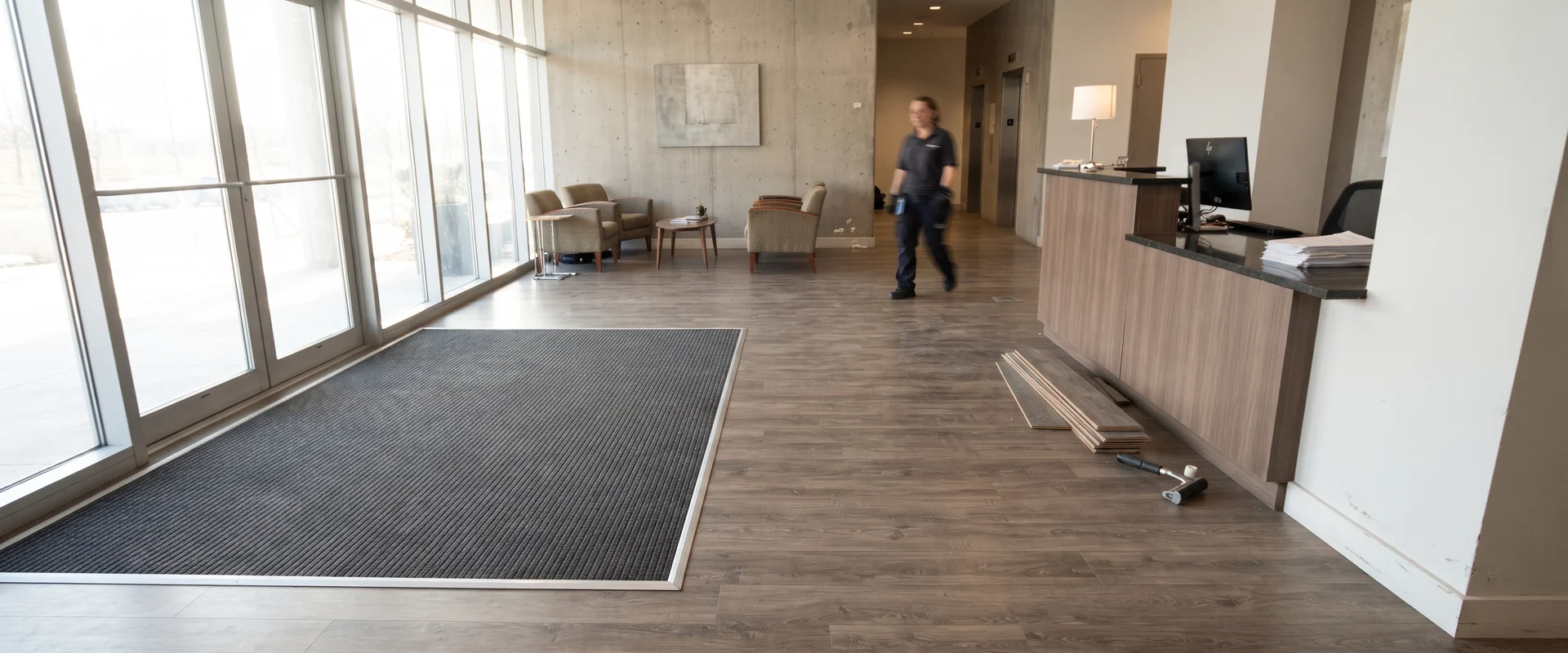
Completed commercial floor at the end of a GTA installation
schedule Written Quote Within 4 Business Hours

Get a Written LVT & VCT Quote for Your GTA Facility

Tell us the facility type, the area, and the work window. You get an itemised CAD quote back within 4 business hours with no obligation and no quote gating.

Assessment $199 CAD, waived when work is authorized on the same visit.

call (647) 277-8977